Resistance Bands for Beginners
Resistance Bands have an image problem. They show up in physical therapy clinics and in the free bonus kit that came with something else, and most people file them under “not real training”
That's worth correcting first, because the misconception is the main reason people who'd be well served by bands never buy them.
A meta-analysis comparing elastic resistance to conventional weights found similar strength gains between the two, though the underlying studies varied a fair amount in quality and design (Lopes et al., 2019). For someone starting out, a band isn't a lesser dumbbell. It's a different tool that gets you to a similar place.
Where bands genuinely differ is in how the resistance behaves, and understanding that is most of what you need.
How Bands Actually Work
A dumbbell weighs the same at every point in the movement. A band doesn't. It gets harder the further you stretch it.
That changes the shape of the exercise. A band curl is easiest at the bottom, where the band is slack, and hardest at the top. A dumbbell curl is the opposite: hardest in the middle, easier once your forearm passes vertical.
Neither is better, but it means bands are naturally good at some things and awkward at others. They're excellent for pulling movements, for anything where you want the most resistance at the end of the range, and for exercises where you'd otherwise need a machine to get the angle right (pulldowns, face pulls, rows, lateral raises.)
They're worse for heavy lower-body work. Your legs are strong enough that producing meaningful squat resistance with a band takes a setup that's more trouble than it's worth. You can train legs with bands and it works fine early on, but that's where you'll outgrow them first.
What to Actually Buy
Three types, different jobs.
Loop bands: the long continuous loops, sometimes sold as pull-up assist bands, are the most versatile. You can anchor them, stand on them, loop them around things. If you buy one type, buy these. Three or four in different strengths covers most of what you'll do.

Loop bands hanging off of a barbell
Tube bands with handles: have grips and usually a door anchor. More comfortable for pressing and rowing because you're holding a handle rather than a rubber loop. Slightly less versatile, noticeably more pleasant for some exercises.
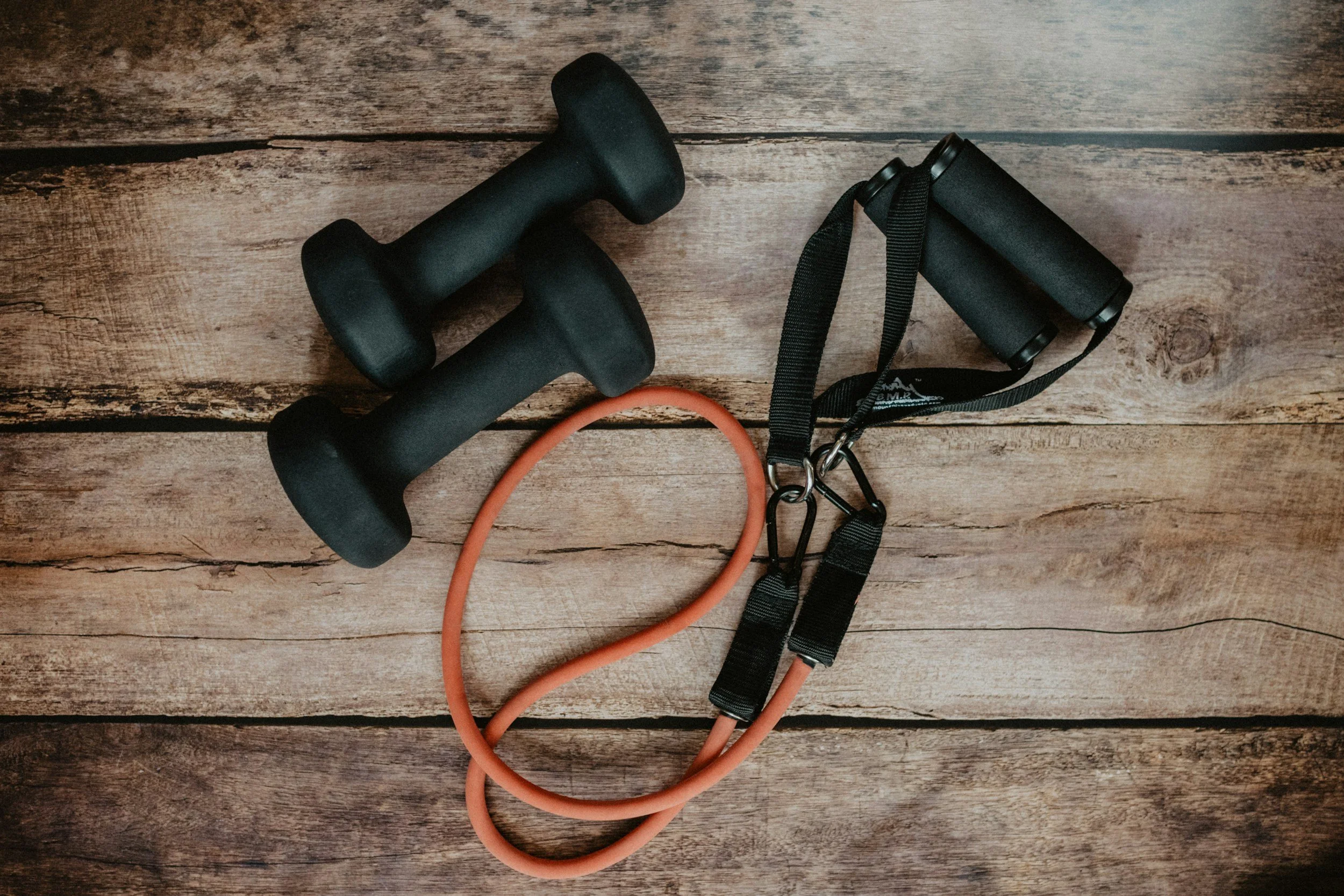
Tube bands with handles posed with a pair of dumbbells
Mini bands: the short loops that go around your thighs. They are usually for hip and glute work, warm-ups, and rehab-type exercises. Cheap and useful, not a training system on their own.
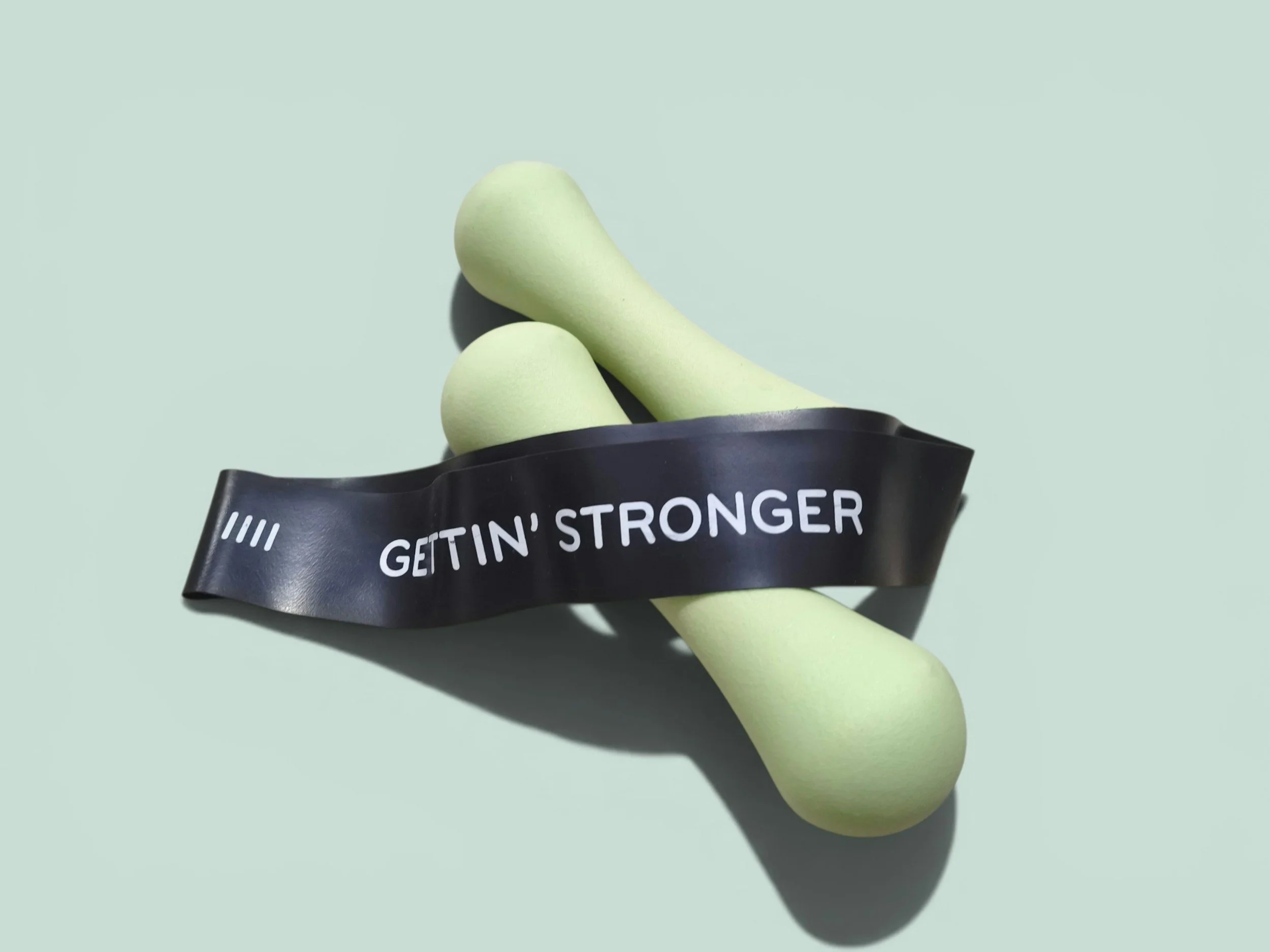
Mini bands are usually smaller in size and often paired with physical therapy exercises
Get a door anchor. It's usually five dollars and it roughly doubles what you can do, turning any doorway into an anchor point at chest, high, or low position.
Fabric is worth the extra cost for mini bands specifically. Latex ones roll and pinch on the thighs. For loop bands, latex is fine.
Buy a range of strengths rather than one band. Progression isn't smooth the way adding five pounds can be on a dumbbell. You move to the next band, shorten the one you have, or change your stance. Having options matters more here than with dumbbells.
The Exercises Worth Learning First
Same movement patterns you'd train with anything else: push, pull, hinge, squat, and something for the core.
For pulling, anchor the band at chest height and row. Have your elbows back, squeeze, control the return. This is where bands shine, and most beginners are underdeveloped in pulling relative to pushing, so it's a good place to spend attention.
For pushing, stand facing away from the anchor with the band behind you and press forward. It's a chest press without a bench. Anchor it low and press upward for a shoulder press variation.
For hinging, stand on the band, hold the ends, and push your hips back while keeping a flat back. That's the Romanian deadlift pattern, and it teaches the hinge. This is the movement most people do worst, and the one most responsible for tweaked backs when you pick something up wrong.
For squatting, stand on the band with the ends at your shoulders. You'll outgrow the resistance quickly, but it works early on.
For the core, anchor at chest height, stand side-on, hold the band at your sternum with both hands, and press it straight out while resisting the rotation. That's a Pallof press, and it trains the core to do what it actually does, which is to prevent movement rather than create it.
Five exercises. Two or three sets of ten to fifteen reps each, twice a week, is a complete beginner program.
Getting the Difficulty Right
This is where most people go wrong, because you can't read the weight off the side.
A band's stated resistance, “15 to 35 pounds”, is a range that depends entirely on how far you stretch it. So you have three ways to make an exercise harder without buying anything: use a stronger band, stand further from the anchor, or take up slack before you start by shortening your grip or widening your stance.
That last one is the most useful and least known. If a band feels too easy at the start of a movement, wrap it once around your hand. You've made the whole range harder.
You're aiming for the same thing you would with weights: the last two or three reps should be genuinely difficult. If you finish fifteen and could have done fifteen more, that's a warm-up. Bands make it easy to drift into that without noticing, because there's no number telling you the load was trivial.
The Honest Limitations
Bands wear out and they can snap. Check yours for nicks before using them, replace them when they look worn, and never stretch one toward your face. Seriously.
You'll eventually outgrow them for the lower body. Upper body takes much longer, and for many people training two or three times a week for general health, it may never really arrive.
Progress is harder to track. With dumbbells you know you went from 20 to 25. With bands you have to note which band, what stance, what grip, which makes writing it down more important.
And the resistance profile means some exercises just feel wrong. If something feels awkward with a band, it might not be your form. It might be that the movement wants constant load and the band isn't providing it.
Why This Is the Right Starting Point for a Lot of People
Bands cost twenty or thirty dollars. They fit in a drawer. They travel, they're quiet (looking at you apartment dwellers) and they remove essentially every logistical objection to home training.
That's the real argument for them, and it isn't physiological. Consistency does more for your results over a year than almost any other variable, and consistency is largely a function of how much friction sits between you and starting. A set of bands in a drawer in your living room is about as low as that gets.
You can spend a year with bands and a door anchor and be substantially stronger than you are now. That's a cheaper route to the same place.
