How to Modify Exercises for Your Comfort Level
I write this as my wife has taken up exercising in the gym. I realized with all the videos she showed me that one theme kept recurring: you do this exercise this way, or else it is wrong. She is brand new and can’t maintain the same level of fitness as the influencer she is watching that day.
Modifying exercises isn't failing. It's exercising intelligently within your actual capabilities at this moment.
What works for the instructor might not work for you, and that's completely normal.
Why Modification Isn't Optional
The fitness industry often presents exercises as if there's one “correct” way. Follow this exact form. Do this many reps. Use this position.
The reality: Exercise needs to work for your body, not some idealized standard.
Your Body Has Specific Needs
You have your own injury history, mobility limitations, strength levels, body proportions, joint restrictions, pain patterns, and conditions that all affect your movement.
What's “proper form” for someone else might be uncomfortable, painful, or impossible for your body.
Modification Keeps You Exercising
If your only options are “do it exactly as shown” or “stop completely,” you'll stop.
Modification creates a third option: “do a version that works for my body.”
Continuing with a modified version means you're still exercising, still building strength, still getting benefits.
Modification Prevents Injury
Forcing your body into positions it's not ready for creates injury risk.
Modifying to match your current capability is injury prevention, not weakness.
When to Modify
You Feel Sharp Pain
Muscle burn or fatigue is normal. Sharp, shooting, or stabbing pain is not.
If you feel:
Sharp pain in joints
Shooting pain down limbs
Pain that makes you wince
Pain that doesn't fade when you stop
Modify immediately. Pain signals something isn't working.
You Can't Complete the Movement
If you physically cannot do the movement as demonstrated, for whatever reason, modify instead of struggling through poor form.
Modify to a version you can actually complete with reasonable control.
It Aggravates an Existing Issue
If you have a previous injury, chronic condition, or known limitation, certain exercises will aggravate it.
Modify before starting to prevent any pain risks.
You Feel Unstable or Unsafe
If an exercise makes you feel like you're going to fall, lose balance, or hurt yourself, modify for stability.
Balance develops with practice. While building it, use more stable variations.
The Standard Version Doesn't Fit Your Body
Some exercises simply don't accommodate certain body proportions or sizes well.
Very tall people, larger bodies, long limbs, and shorter limbs all create different leverage and positioning challenges.
Modify to work with your body, not against it.
How to Modify Common Exercises
Push-Ups
Standard push-ups require significant upper-body and core strength.
Easier options (easiest to hardest):
Wall push-ups: Stand facing the wall, hands on the wall at shoulder height, lean in, and push back. Almost everyone can do these.
Counter push-ups: Hands on counter or table, body at an angle. More challenging than the wall.
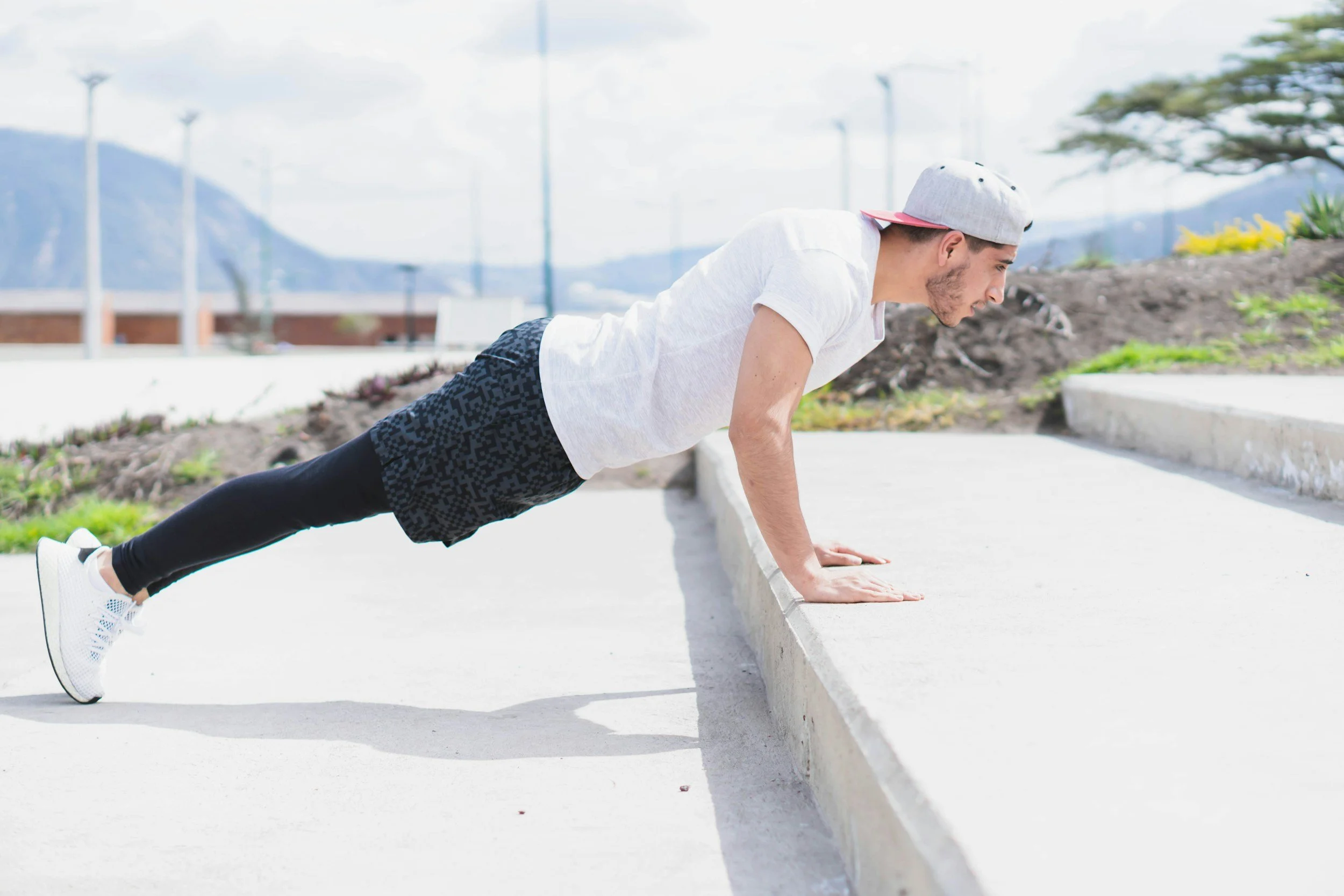
Elevated push-ups: Hands on bench. The higher the surface, the easier.
Knee push-ups: On the floor with knees down instead of toes.
Slow lowering: Start at the top, lower down slowly, and drop to your knees to push back up. Builds strength for full push-ups.
Start where you can complete 8-12 reps with good form. Once easy, move to a slightly harder variation.
Squats
Standard squats assume good hip and ankle mobility.
Modifications for different issues:
Limited mobility: Don't go as deep. Partial squats still work the legs.
Balance problems: Hold onto something stable (doorframe, chair back).
Knee discomfort: Don't go as deep. Sit back more like sitting in a chair.
Need target: Sit on a bench or a chair, then stand. This gives a depth target and catches you if needed.
Alternative: If squats don't work, try step-ups, leg press, or different leg exercises.
Planks
Many people can't hold the standard plank long enough to benefit.
Modifications:
Elevated: Hands or forearms on a bench instead of the floor. Higher = easier.
Knee plank: Forearms and knees on the floor, creating a straight line from head to knees.
Shorter holds: 10-15 seconds, rest, repeat. Total time matters more than a single hold.
Alternative: If planks hurt wrists or shoulders, try dead bug or bird dog instead.
Lunges
Lunges challenge balance and require mobility.
Modifications:
Hold something: Use a wall or doorframe for light balance assistance.
Reduce range: Don't step as far or go as deep.
Split squat: Start in a lunge position. Don't step anywhere, just lower and raise. Removes the balance-challenging step.
Reverse lunge: Step backward instead of forward. Often feels more stable and knee-friendly.
Alternative: If lunges don't work, try step-ups (low step initially).
General Modification Principles
Reduce Range of Motion
You don't need a full range if you can't control it.
Partial squats, smaller arm movements, and shorter steps will all still work muscles.
Partial range with control beats full range with compromised form.
Lighten the Load
Use lighter weight, fewer reps, or bodyweight when the demonstrated version uses equipment.
Progress your load gradually as your strength builds.
Slow Down
Slowing down often makes exercises easier to control and safer.
Slow down jumps (or remove them), take more time through complicated movements, and pause at difficult points.
Reduce Impact
High-impact is hard on joints.
Step instead of jump. March instead of running. Reduce jump height. One foot at a time instead of both.
Low-impact still provides benefits.
Use Support
There's no shame in using walls, chairs, bands, or machines for assistance.
Assistance allows you to practice movement patterns while building strength.
Asking for Modifications
In Group Classes
Say this: “I have (knee issues/shoulder limitations, etc.). What modification would you suggest for this??
Most instructors appreciate being asked. They'd rather you modify (and come back!) than get hurt.
With Trainers
Be upfront about limitations, previous injuries, what hurts, and what doesn't feel right.
Good trainers work with your body as it is.
Following Online Workouts
Pause the video, think through how to modify, then resume. You don't need to keep up in real-time.
Many channels include modifications, or search for “(exercise name) modifications.”
When You Don't Know How to Modify
If you're unsure:
Skip that exercise and do something else you know works.
Do the easiest version imaginable (wall push-ups, partial squats, knee planks).
Research modifications before the next workout.
Work with a professional who can teach modifications for your needs.
Skipping one exercise is better than forcing through and getting injured.
Progressing Beyond Modifications
Modifications aren't forever. As you build strength and mobility, many will progress toward standard versions.
How to progress:
When the modified version feels easy (12+ reps with good form)
Try the next level for a few reps
If successful, start mixing the harder version in
Gradually shift to a harder version completely
Example: Knee push-ups feel easy → Try 3 regular push-ups → Can do 5 → Mix regular with knee push-ups → Eventually all regular
Progress happens over weeks and months, not overnight.
The Bottom Line
Modifying exercises isn't failure. It's intelligence.
What works for someone else might not work for you, and that's okay.
Modification allows you to:
Keep exercising instead of stopping
Prevent injury
Build strength at your pace
Work with your actual capabilities
The “best” version of any exercise is the version you can do with reasonable form, without pain, that builds your strength over time.
That might be the standard version. It might be a modification. Both are legitimate exercises.
Remember: Any movement beats no movement because you're forcing a version of exercise your body isn't ready for.
