Yes, it is actually true: you can build legitimate strength with less than $100 worth of gear.
Walk through any sporting goods store and you'll see intimidating price tags: $2,000 treadmills, $600 smart bikes, elaborate cable systems that cost more than rent. The message is clear: real fitness requires serious investment.
That message is wrong.
This guide shows you how to build a functional home gym across three budget levels: under $100, around $300, and $500-600.
Our focus is on equipment that won't intimidate you, actually fits in normal living spaces, and gets used instead of becoming expensive furniture that you hang your clothes on to dry.
What Separates Useful Equipment from Expensive Clutter
Before diving into specific products, understand the criteria that determine whether equipment earns its space and cost.
Versatility beats specialization. One tool that enables 15 exercises beats three tools that each do five. When the budget is limited, every purchase needs to justify itself through multiple uses.
Progression matters more than initial challenge. Equipment you outgrow in three weeks wasn't worth buying. Look for adjustable resistance or ways to increase difficulty as you adapt.
Space reality. Most people don't have spare rooms for home gyms. Equipment needs to store compactly or be small enough to exist in bedroom corners or living room edges without dominating the space.
Psychological accessibility. Complicated setups create avoidance. Simple, intuitive equipment gets used more consistently than sophisticated gear that intimidates you.
Tier One: Under $100 (The Foundation)
If you're uncertain whether home training will stick, start here. This tier provides everything needed for complete strength training without significant financial risk.
Resistance Band Set ($20-35)
Resistance bands might look unimpressive compared to weights, but they're arguably the most versatile single purchase you can make for home training.
These stretchy loops or tubes replace dozens of exercises typically requiring dumbbells or machines: squats, chest presses, rows, shoulder raises, curls, extensions, leg lifts. They're also significantly less intimidating than metal weights for people who've never strength trained before.
Selection criteria: Look for sets including multiple resistance levels. A hint here is that they are usually color-coded from light to heavy and range approximately 5-50 pounds of tension. Sets with door anchors and handles dramatically expand exercise options. Loop bands work great for lower body movements; handled bands open up more upper body possibilities.
What you need to know: Bands feel different than weights. Resistance increases as you stretch them, so the hardest point comes at full extension rather than mid-movement. They're also gentler on joints, which helps when learning new movement patterns.
Check out Resistance Bands Here
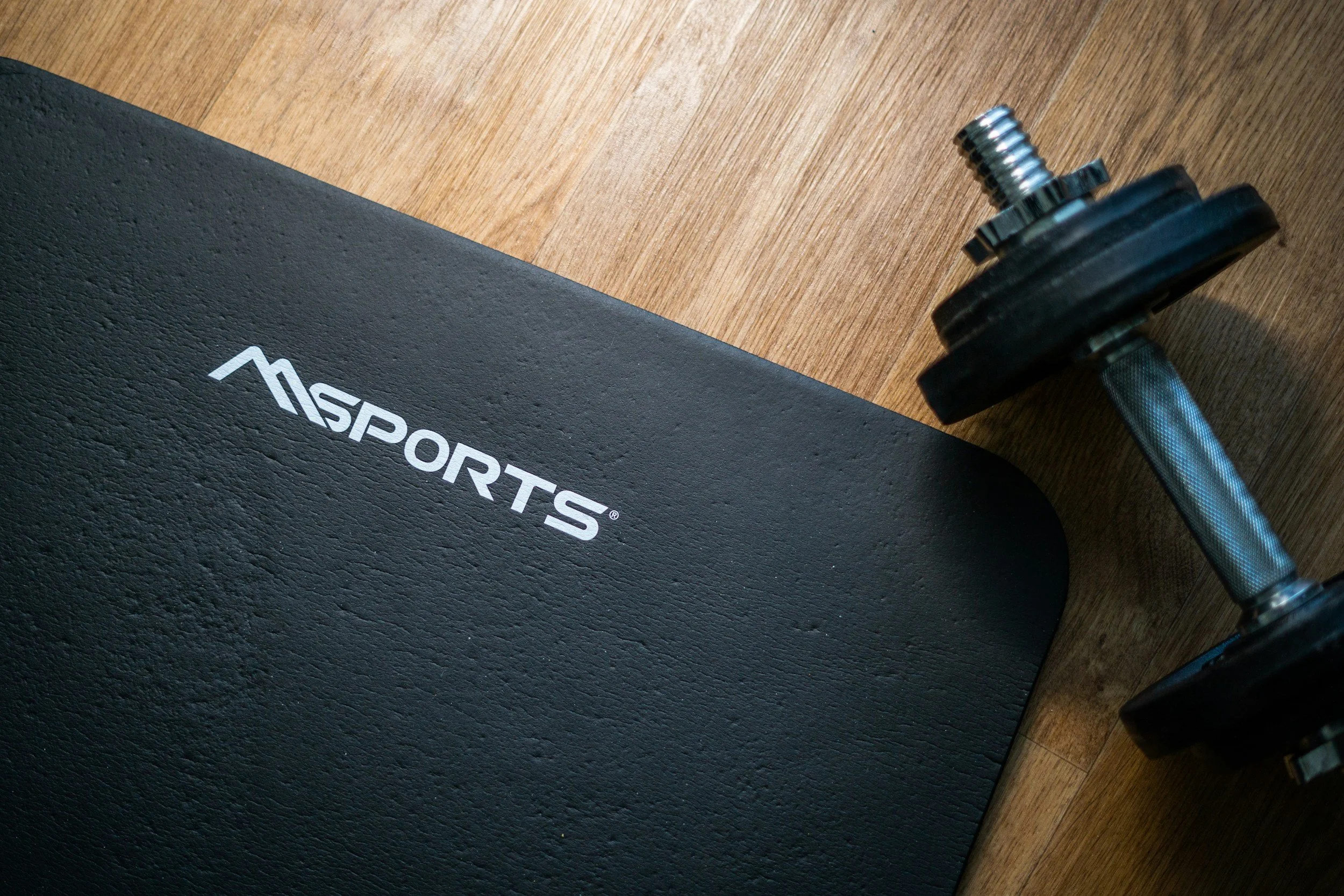
Exercise Mat ($20-40)
Even if yoga isn't your thing, you need a mat. It's your cushioned surface for anything on the floor: planks, push-ups, core exercises, and stretching. Hard floors are uncomfortable and discourage floor-based movements. Carpet creates instability and makes certain exercises awkward.
Selection criteria: Thickness determines comfort. 6mm (about 1/4 inch) balances cushioning with stability. You want it thick enough to protect knees and elbows but not so thick you feel wobbly. Budget mats under $15 compress quickly and become slippery when wet.
Length matters for taller people. Standard mats run 68 inches; if you're over 6 feet, look for 72+ inch versions.
What you need to know: Premium yoga mats ($80-120) offer marginal benefits for home strength training. Mid-range options ($25-40) perform nearly identically unless you're doing intensive daily yoga practice.
Doorway Pull-Up Bar ($25-40)
This solves your pulling movement problem. Pulling exercises (rows, pull-ups, chin-ups, hanging core work) are essential for balanced strength development and often neglected in home training because people lack the right tools.
Selection criteria: Choose doorway-mounted bars requiring no permanent installation which means no screws, no wall anchors, no damage. These function through leverage pressure against door frames. Verify it fits your doorway width (most accommodate 25-36 inches, but measure first).
Weight capacity typically ranges 220-300 pounds. Check specifications to ensure it handles your weight safely.
What you need to know: If you can't do pull-ups yet (most beginners can't), this bar still serves multiple purposes. Use it for dead hangs to build grip strength. Loop resistance bands over it for assisted pull-ups. Practice bent-arm hangs. You're not buying this to immediately perform 10 perfect pull-ups, you're buying it to work toward that capability over months.
Check out this Doorway Pull Up Bar
Tier One Total Investment: $65-115
These three items enable training for every major muscle group: legs, chest, back, shoulders, arms, and core. You won't have the variety of a commercial gym, but you have enough to build genuine strength.
Tier Two: $200-350 (Expanding Capability)
If you've trained consistently for several weeks and have built commitment, or if you want more options from the start, this tier adds significant capability and variety.
Adjustable Dumbbells ($150-250)
Dumbbells represent the gold standard for home strength training. They feel intuitive to most people, allow progressive loading beyond what beginners initially need, and enable unilateral work (training one side independently, which helps address strength imbalances).
The adjustable aspect is crucial. Purchasing individual fixed-weight dumbbells from 5-50 pounds would cost $500+ and demand substantial storage space. Adjustable dumbbells compress 10-15 weight increments into two compact units.
Selection criteria: Two main systems exist: dial-adjustable (like Bowflex SelectTech) and pin-adjustable. Dial systems change weight faster but cost more. Pin systems are cheaper but require manually inserting and removing pins for each adjustment. Neither is the correct method, just think what you need.
Weight range considerations: Most women start using 5-25 pounds across different exercises. Most men start using 10-40 pounds. Sets ranging 5-50 pounds serve most beginners for years of progression.
What you need to know: This represents the largest single investment in this tier. It's worthwhile if you're serious about home training. However, if $200+ feels prohibitive right now, resistance bands work perfectly fine and you can add dumbbells later. Don't let equipment costs prevent you from starting.
Bowflex makes a very good adjustable dumbbell
Yes4All also makes a more budget alternative
Adjustable Weight Bench ($100-150)
A bench transforms what's possible with dumbbells. Chest presses, incline presses, supported rows, step-ups, Bulgarian split squats, decline core work, just to name a few.
Selection criteria: Adjustable incline is essential. Flat, incline, and decline positions triple your exercise options compared to flat-only benches.
Weight capacity should exceed 500 pounds. You want a bench that accounts for your bodyweight plus the weights you're holding. Budget benches rated at 300 pounds might work initially, but feel unstable as you progress.
Foldability helps if space is limited. Many quality benches fold and slide under beds.
What you need to know: You can definitely train without a bench. Floor presses work well, and elevated surfaces like sturdy couches or chairs substitute temporarily. But proper benches make exercises more comfortable and effective. If choosing between dumbbells and a bench, prioritize dumbbells first.
Check out an Adjustable Weight Bench option here
Foam Roller ($15-30)
Recovery matters as much as workouts themselves, especially when you're new and experiencing more soreness. Foam rolling aids muscle recovery, helps reduce soreness intensity, and improves flexibility over time.
Selection criteria: Medium density (firm but not rock-hard) works for most people. Too soft provides minimal benefit. Too firm causes excessive discomfort. Standard length (36 inches) provides enough surface for full back rolling.
What you need to know: Foam rolling won't make or break your fitness journey, and to be honest, it's the lowest priority item in this tier. But if you're consistently sore after workouts (normal when starting), this noticeably improves comfort levels.
Tier Two Total Investment: $280-460
This tier includes everything from Tier One plus adjustable dumbbells, a bench, and a foam roller. This setup creates a genuinely complete home gym rivaling what most commercial gyms offer for basic strength training.
Tier Three: $400-600 (Complete Home Setup)
If you're committed long-term and want maximum capability without reaching four-figure costs, this tier adds specialty equipment that significantly expands training options.
Suspension Trainer System ($60-180)
Suspension trainers (TRX being the most recognized brand) use your bodyweight with adjustable angles to create hundreds of exercise variations. They excel at core stability work, unilateral exercises, and creating progressive difficulty without changing weight.
Selection criteria: Adjustable strap length is non-negotiable. Included door anchor enables use with doorways similar to your pull-up bar. Weight capacity should exceed 400 pounds.
What you need to know: TRX is the name brand with excellent products, but budget suspension trainers at $60-80 perform nearly identically for home use. The TRX premium might justify itself for professional use or multi-person training, but budget options work perfectly for personal home training.
Check out the TRX Home System here
Kettlebell (Single or Adjustable) ($30-200)
Kettlebells enable explosive movements (swings, snatches, cleans) that dumbbells and bands don't replicate effectively. They're also excellent for lower body loading and conditioning work. The offset weight distribution (weight hangs below the handle) creates different stability demands than dumbbells.
Selection criteria: For most beginners, one 15-20 lb kettlebell (typically for women) or 25-35 lb kettlebell (typically for men) suffices initially. Adjustable kettlebells exist but cost more. They're worthwhile if you know you'll use them regularly.
What you need to know: Kettlebells are fantastic but not essential when starting. If choosing between adding a kettlebell or upgrading to heavier adjustable dumbbells, prioritize the dumbbells. Add kettlebells after you've mastered basic strength patterns and want to explore dynamic/explosive training.
Check out an adjustable option here
Check out a single weight option here
Jump Rope ($10-25)
Cardio conditioning without the price tag. Jump rope delivers brutally effective cardiovascular training, costs almost nothing, requires zero space, and works in living rooms (assuming downstairs neighbors can tolerate it) or driveways.
Selection criteria: Adjustable length accommodates your height. Ball bearing swivel creates smoother rotation. Comfortable handles reduce hand fatigue.
What you need to know: Start with basic $10-15 ropes. Fancy weighted rope systems ($60-100) are excellent, but they're overkill until you can consistently jump rope for 3-5 minutes without stopping. Most beginners underestimate jump rope difficulty. I know I did.
Stability Ball ($20-35)
Adds instability to exercises (forcing more core engagement), serves as a bench alternative, works excellently for core-specific exercises, and proves useful for stretching and mobility work.
Selection criteria: Size depends on your height:
55cm: under 5'5"
65cm: 5'6" to 6'0"
75cm: over 6'0"
Anti-burst rating ensures it deflates slowly if punctured rather than exploding. Look for 2000+ pound test ratings.
What you need to know: Stability balls are useful but not essential. They're the first item I'd remove from this tier if budget tightens. That said, if you have $20-25 remaining in your budget, they add variety and some people genuinely enjoy training with them.
Check out an exercise ball here
Tier Three Total Investment: $570-640 (including all previous tiers)
This represents a comprehensive home gym enabling virtually any beginner-to-intermediate strength training or conditioning workout. You won't have the specific machines of commercial gyms, but you'll have more versatility and zero commute time.
Setting Up Your Training Space
Owning equipment doesn't help if it stays buried in closets. Here's how to arrange your home gym for actual use:
Designate a specific area. Even if it's just a bedroom corner, dedicate one spot as your training space. This mental association makes starting easier.
Maintain visibility. Equipment you see gets used. Resistance bands hanging on hooks, dumbbells on small shelves or racks—visible equipment creates environmental cues prompting action.
Create invitation, not obligation. This sounds minor but matters significantly. If your training space feels depressing, you'll avoid it. Consider a plant, decent lighting, maybe a small speaker for music—these details affect whether you actually use the space.
Organize storage thoughtfully. Dumbbells on floors create tripping hazards and feel cluttered. Simple weight racks or sturdy shelves make spaces feel more intentional.
Consider flooring protection. If dropping weights or doing jumping exercises, foam exercise mats or interlocking foam tiles (approximately $30-50 for small area coverage) protect floors and reduce noise for people below you.
Strategic Budget Planning
If you're uncertain where to start, here's a practical staged approach:
Month 1: Purchase Tier One essentials ($65-115) Resistance bands, exercise mat, pull-up bar. Train with these for 4-6 weeks. Notice what you miss, what you wish you had, which exercises feel limited.
Months 2-3: Evaluate and expand If you're still training consistently (3+ times weekly for 6+ weeks), you've proven this will stick. Consider adding adjustable dumbbells and a bench if budget permits.
Month 4+: Add specialty equipment Only after establishing genuine consistency (3+ months of regular training) should you consider specialty equipment like suspension trainers or kettlebells. By this point, you'll understand what you actually want based on your training preferences.
This staged approach prevents spending $500 on equipment that sits unused because you weren't actually ready to commit. It also provides time to learn what you genuinely enjoy and need.
Final Thoughts
Here's what years of observing people set up home gyms reveals: the most effective home gym is the one you consistently use.
Fancy equipment doesn't automatically create results. A simple setup used four times weekly beats an elaborate home gym used monthly because setup feels overwhelming.
Start smaller than you think necessary. You can always add equipment. You can't recover the $500 spent on gear that intimidates you into avoiding workouts.
What matters is whether you show up consistently. Whether you progressively challenge yourself over weeks and months. Whether you build sustainable practice instead of burning out in three weeks.
The best home gym equipment for beginners is whatever equipment you'll actually use. A $25 resistance band used four times weekly is infinitely more valuable than $500 of dumbbells sitting in closets.
Start with basics. Use them consistently. Add equipment only after proving to yourself you'll use it.
Your body doesn't care about equipment cost. It only responds to consistent challenge over time. Everything else is just details.
Quick Reference Shopping Guide
Under $100 Starter Kit:
Resistance band set with handles: $20-35
Exercise mat (6mm thickness): $20-40
Doorway pull-up bar: $25-40
Tier Total: $65-115
$200-350 Expanded Setup (adds to Tier 1):
Adjustable dumbbells (5-50 lbs): $150-250
Adjustable weight bench: $100-150
Foam roller: $15-30
Cumulative Total: $330-545
$400-600 Complete Setup (adds to previous tiers):
Suspension trainer: $60-180
Kettlebell (single or adjustable): $30-200
Jump rope: $10-25
Stability ball: $20-35
Cumulative Total: $500-985
(Note: Prices reflect typical ranges as of February 2026 and may vary by retailer, sales, and availability)
Affiliate Disclosure: This article contains affiliate links. If you purchase through these links, we may earn a small commission at no additional cost to you. We only recommend products aligning with our mission of helping beginners build sustainable, approachable fitness practices. Your support enables us to continue creating honest, helpful content that we believe in.
