How to Find Joy in Small Wins
We’re all working toward something. It can be fitness, health, or feeling better in your body. You're putting in effort, showing up, and doing the work.
But the big goal feels distant. The scale hasn't moved. You don't look different. You can't see tangible results yet.
So you feel discouraged. It almost (or sometimes does) feel like your effort doesn't matter. Like you're spinning your wheels.
By focusing on the above, there are small wins happening every day that you're not noticing or celebrating.
You showed up when you didn't feel like it. You chose water over soda. You got one more rep than last week. You stretched for five minutes.
These feel insignificant compared to your big goal. But they're not. They're the foundation upon which everything is built.
Why Small Wins Actually Matter
Big transformations don't happen in a single moment. They happen through accumulated, small actions over time.
They Build Evidence That You Follow Through
Each small win creates proof you're capable of keeping commitments to yourself.
You said you'd work out today. You did. That's evidence.
Tomorrow, when your brain doubts whether you'll actually do it, you have yesterday's completion as counter-evidence.
Small wins accumulate into a belief that you're someone who does what you say.
They're What You Control
You can't control:
How fast your body changes
Whether the scale moves this week
Genetic factors affecting results
You can control:
Whether you show up for your workout
What you eat today
How much sleep do you get
Whether you take your walk
Small wins focus on what's within your power. This creates agency instead of helplessness.
They Happen Frequently
If you only celebrate reaching your big goal (losing 30 pounds, running a 5K), you might wait months or years.
Small wins happen daily or weekly. They provide frequent positive reinforcement that keeps you going.
They Prevent All-or-Nothing Thinking
When only the big goal counts, anything less feels like failure.
All-or-nothing: “I didn't lose weight this week, so this week was a failure.”
Small wins: “I didn't lose weight, but I completed all my workouts, tried a new healthy recipe, and slept well five nights. Those are wins.”
Research shows that recognizing and celebrating little progress increases motivation and persistence toward long-term goals (Amabile & Kramer, 2011).
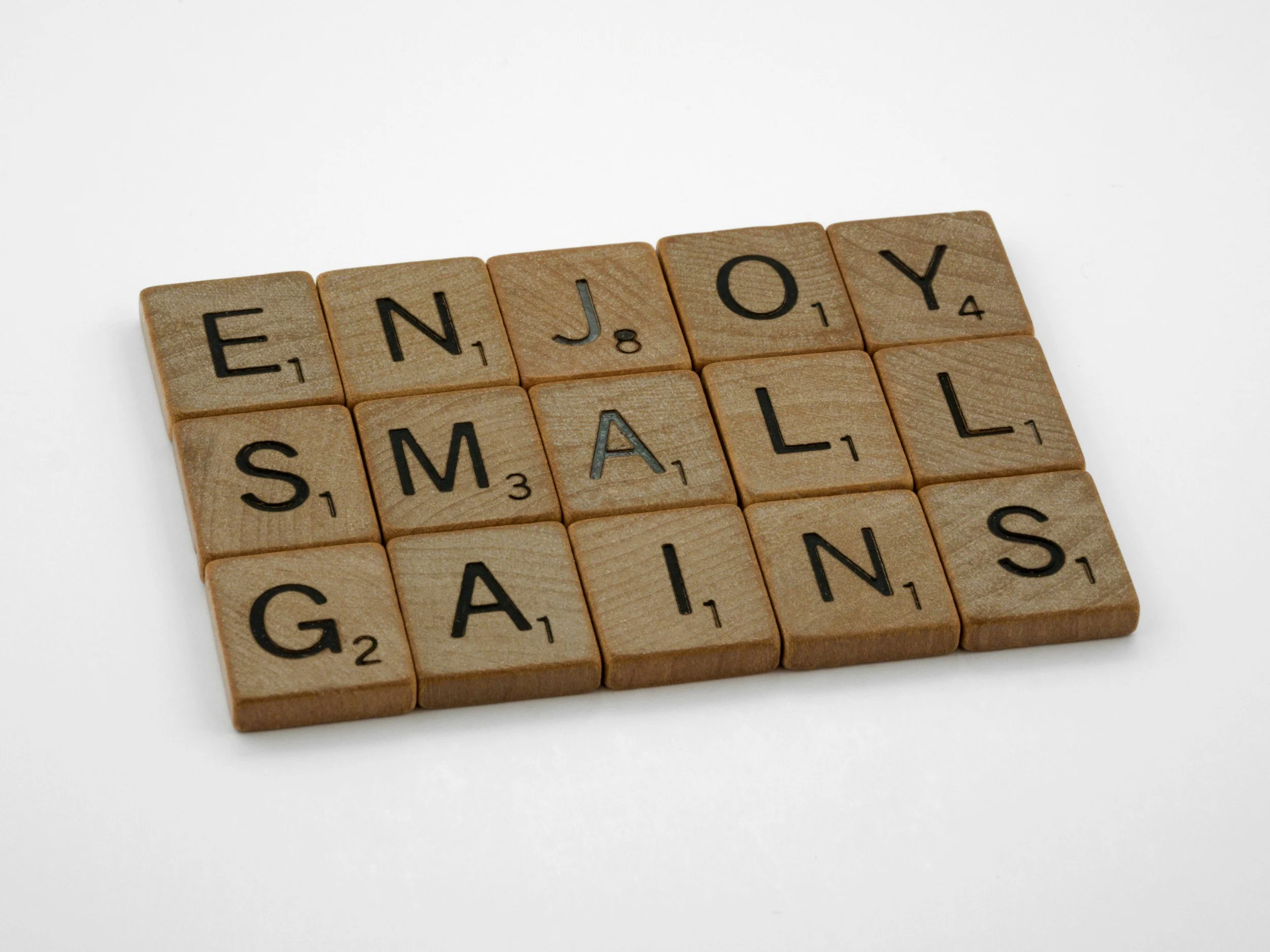
What Counts as a Small Win
You're probably having small wins daily but not registering them.
Showing Up Counts
Going to the gym when you didn't want to
Starting your workout when motivation was zero
Doing 10 minutes when you couldn't manage your full workout
Choosing movement over sitting when tired
Showing up is a win regardless of performance.
Consistency Counts
Completing your third workout this week
Eating healthy for five consecutive days
Not missing a workout two weeks in a row
Maintaining any habit for 30 days
Consistency itself is an achievement.
Tiny Progress Counts
One more rep than last week
Five more pounds on the bar
Walking one minute longer
Holding a plank for five seconds more
Tiny improvements compound themselves.
Choices Count
Choosing water over soda
Eating the meal you prepared instead of ordering out
Going for a walk instead of scrolling
Choosing sleep over late-night TV
Every aligned choice is a win, even when no one sees it.
Learning Counts
Understanding how to use new equipment
Learning proper form
Figuring out what foods make you feel good
Recognizing your patterns
Knowledge gained is progress even without physical changes.
How to Notice Small Wins
You're having small wins, but not registering them.
Track Actions, Not Just Outcomes
Instead of only tracking:
Weight
Measurements
Appearance
Also track:
Days you worked out (X on calendar)
Workouts completed this month
Hours of sleep
Weeks of consistency
Actions give you wins to celebrate regardless of outcome metrics.
End Each Day With One Win
At the end of each day, identify one small win.
They can be tiny:
“Drank enough water.”
“Did my workout even though I felt tired.”
“Chose fruit instead of chips.”
Why this works: You're training your brain to look for wins instead of only noticing what went wrong.
Notice Non-Scale Changes
Pay attention to:
More energy
Better sleep
Improved mood
Clothes fit differently (even if the weight is the same)
Exercises feeling easier
More confidence
Reduced pain
These are legitimate wins often overlooked while fixating on scale.
Compare to Your Past Self
Unhelpful: Current self vs. fitness influencers or people further in their journey.
Helpful: Current self vs. yourself last month or three months ago.
Ask: What can I do now that I couldn't do then?
Make Progress Visible
Small wins are easy to forget. Making them visible helps you see accumulation.
Simple options:
Calendar with X for each workout
Habit tracker showing streaks
A list on your phone of wins from this month
Jar where you add something for each win
Seeing accumulated wins creates tangible evidence.
Finding Actual Joy in Small Wins
Noticing intellectually is different from feeling genuine joy.
Let the Win Stand Alone
Many people negate their wins: “I worked out, but it was only 20 minutes.” “I ate healthy, but I should've done it all week.”
The “but” erases the win. More often than not, anytime the connector “but” is used, it negates the first half of any sentence because it only leaves one with what came after.
Try: Let phrases stand on their own. “I worked out for 20 minutes.” “I ate healthy today.”
No qualifiers. Just the win.
Celebrate Immediately
Don't wait until the end of the week or the month.
Small immediate celebrations:
Moment of acknowledgment: “I did that.”
Check mark on calendar
Saying “win” out loud
Brief pause to feel good about it
Immediate acknowledgment reinforces the behavior.
Expand What “Counts”
If only big achievements count, you'll rarely feel successful.
Make these count:
Trying (even if execution was imperfect)
Showing up (even if performance was bad)
Learning (even if you haven't mastered it)
Resuming after a break (even if you wish you hadn't broken the streak)
More things to count mean more opportunities for joy.
Notice What Your Body Can Do
Instead of only focusing on what your body can't do yet or doesn't look like yet, notice what it can do.
Shift: From: “I can only do 5 push-ups, I should be able to do 20." To: “My body can do 5 push-ups. Three months ago, I couldn't do any.”
From: “I'm still not where I want to be.” To: “My body carried me through a full workout today.”
Gratitude for current capabilities creates joy now, not just deferred joy in future achievements.
When Small Wins Don't Feel Like Enough
Sometimes knowing small wins matter doesn't make them feel satisfying.
You're Impatient for Big Results
Normal. You want dramatic change. Small wins feel insignificant.
Remember: Big results are accumulated from small wins. The small wins are building blocks, not separate from the big goal.
You're Comparing to Others
Small wins feel tiny when compared to other people's big achievements.
Remember: You're seeing their current state without knowing their starting point. Your small wins are building your own trajectory.
You're Discounting Imperfection
If only flawless execution counts, small imperfect wins won't feel good.
Remember: Small imperfect action beats waiting for perfect conditions.
The big transformation you're working toward is built entirely from accumulated small wins.
The small ones are happening today. Find joy in them.
